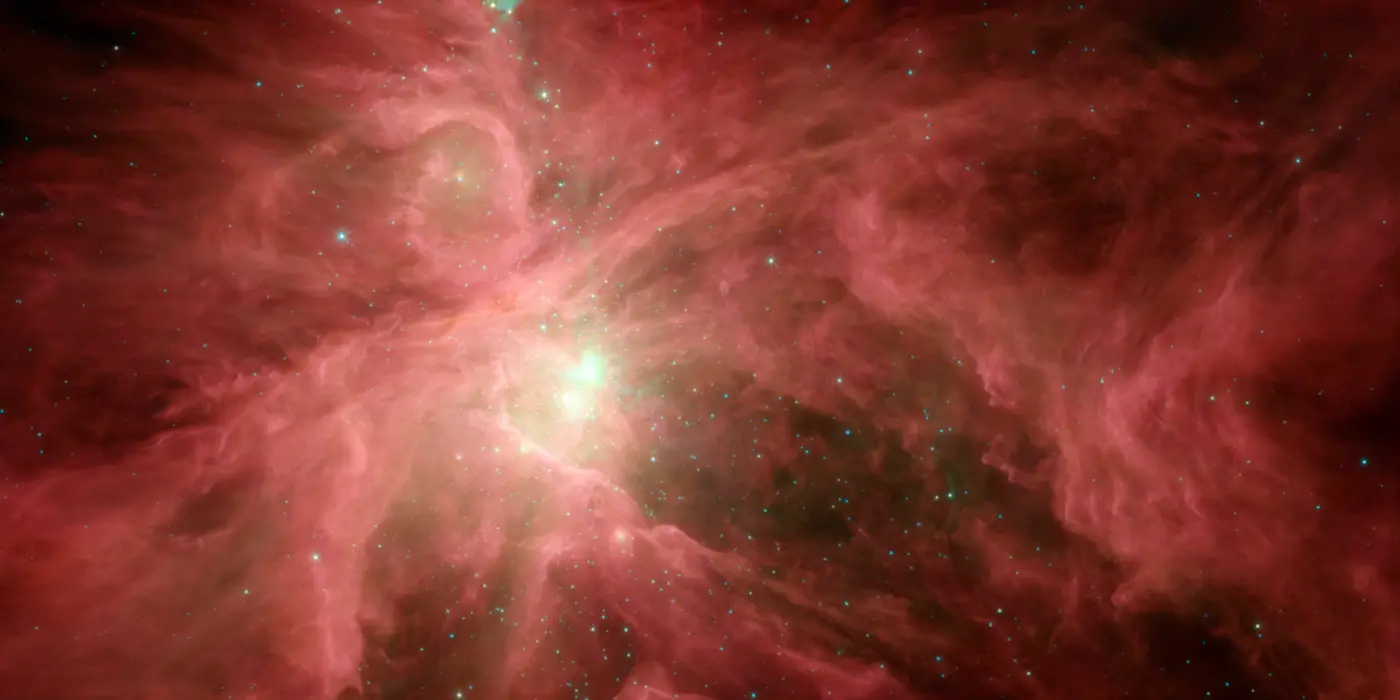
PDRs4All science goals: radiative feedback from massive stars
Radiative feedback from massive stars as traced by multiband imaging and spectroscopic mosaics.
Massive stars disrupt the molecular cloud they were born in. They dissociate molecules, ionize atoms and molecules, and heat the gas and dust. These processes drive the evolution of interstellar matter in our Galaxy and throughout the Universe, from the era of vigorous star formation at redshifts of 1 to 3 to the present day.
Much of this interaction happens in photodissociation regions (PDRs), where the far-ultraviolet photons of massive stars create a largely neutral but warm region of gas and dust. PDR emission dominates the infrared spectra of star-forming galaxies. It is also a unique tool for studying the physical and chemical processes that matter for most of the mass in inter- and circumstellar media: diffuse clouds, the surfaces of protoplanetary disks and molecular clouds, globules, planetary nebulae and starburst galaxies.
The team proposes to provide template datasets designed to identify key PDR characteristics in JWST spectra, to guide the preparation of Cycle 2 proposals on star-forming regions in our Galaxy and beyond. The plan is to obtain the first spatially resolved, high spectral resolution infrared observations of a PDR using NIRCam, NIRSpec and MIRI. These data will test widely used theoretical models and extend them into the JWST era.
The broader community is already involved: the program is supported by an international team of 138 scientists. Science-enabling products will guide observational planning and allow fast data analysis, and the team will train the community through telecons and dedicated workshops.
See also the AstroPAH Newsletter, Issue 49, June 2018.