PDRs4All: a JWST Early Release Science program on radiative feedback from massive stars
This website belongs to an observing program for the James Webb Space Telescope (JWST), selected as one of the Early Release Science (ERS) programs.
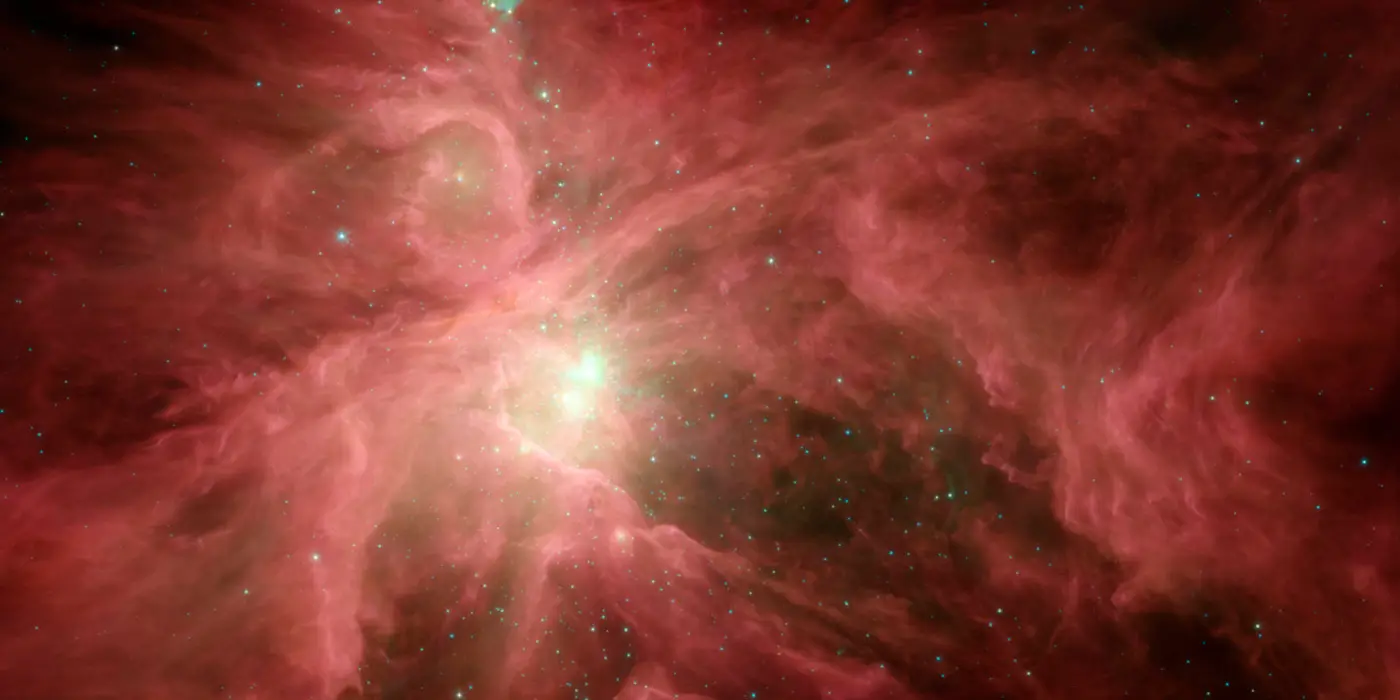
The program studies photodissociation regions (PDRs): places where the far-ultraviolet photons of massive stars create a largely neutral but warm region of gas and dust. The team plans to obtain the first spatially resolved, high spectral resolution observations of a PDR and to provide template data and science-enabling products for PDRs. The scientific objective is described on the goals page; the program overview and the technical details are published on the JWST website.
Who runs the program
PDRs4All is coordinated by an international core team of 20 scientists and supported by science collaborators. The PI team is made up of Olivier Berné, Emilie Habart and Els Peeters.
What Early Release Science means
The launch of the James Webb Space Telescope (NASA/ESA/CSA) was planned for December 2021. During the first months of operations, 500 hours of director's time were set aside for 13 Early Release Science programs. Their purpose is threefold: to give the wider community first-look public data as soon as possible after launch, to test the instruments and observing modes, and to help the community prepare open-time proposals.
Questions about the program go to the PIs at pi-jwstpdr@irap.omp.eu; the project page explains where everything else is.